AI Training Career Paths & Progression
From First Tasks to Top-Tier Roles — See Where AI Training Can Take You
Turn Your Passion for AI Into a Thriving Career
Ready to navigate the $3.2 billion AI data training industry where 1.5 million annotators, evaluators, and specialists worldwide power models like Grok, self-driving cars, and medical diagnostics? With 5,878 remote jobs posted on Indeed in June 2025, opportunities range from $5/hour micro-tasks to $80/hour specialist roles.
Your Roadmap from Novice to Expert
Whether you're a beginner labeling images or a pro aiming for quality assurance (QA) leadership, this page maps out clear career stages, skills, pay ranges, and advancement strategies in a field projected to grow 25% annually through 2030.
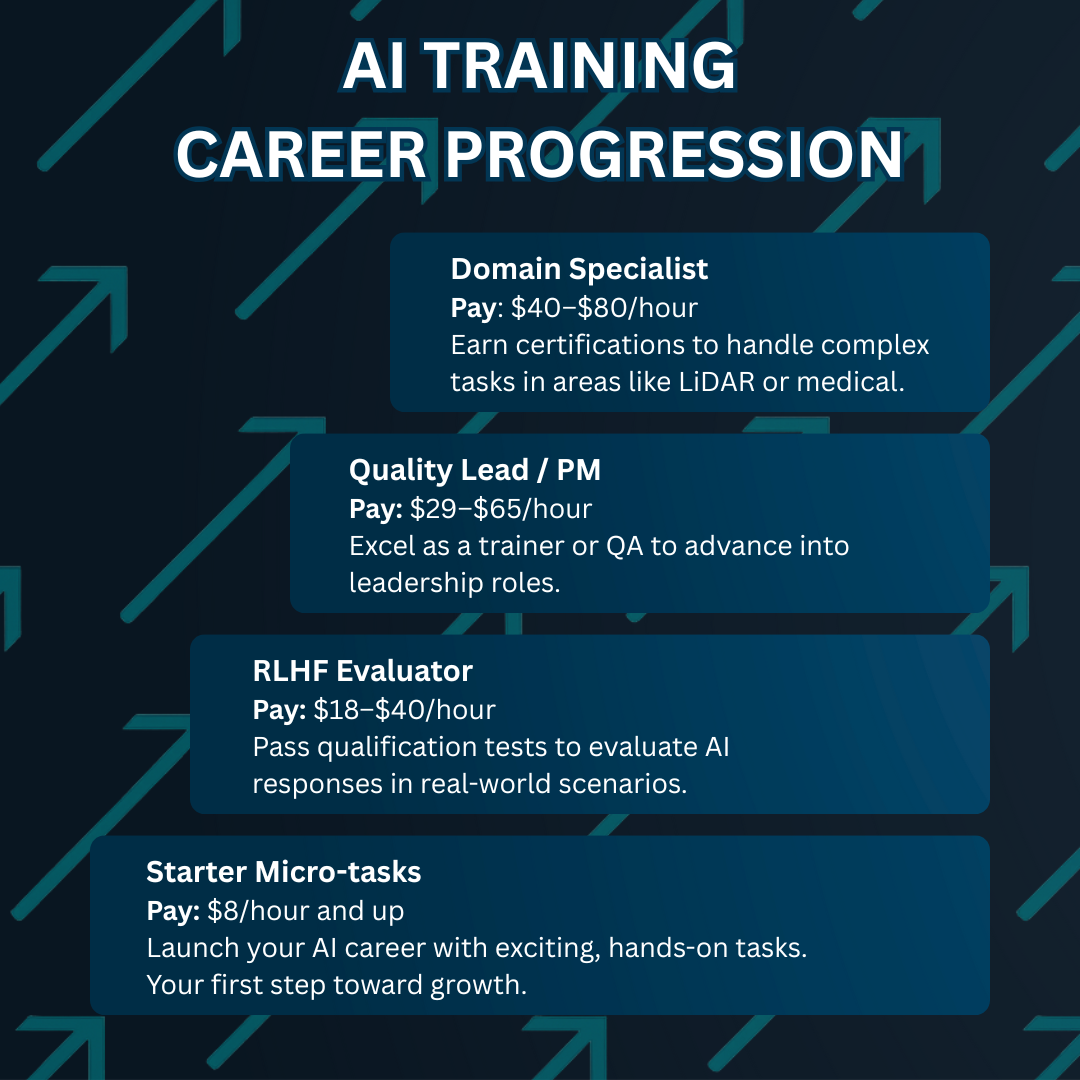
From entry-level annotators earning $5-$15/hour to domain specialists making $40-$80/hour, your skills can unlock a rewarding career with global impact. Start your journey today!
Why a Career in AI Data Training?
Human-in-the-Loop Impact
AI data training is the HITL backbone of artificial intelligence, ensuring models are accurate, safe, and ethical. Human input boosts model performance by 20-30% and stays essential through 2030.
Flexible Remote Opportunities
Whether you're detail-oriented, analytical, or specialized in fields like medicine, this industry offers flexible, remote roles with clear progression paths worldwide.
Clear Career Progression
From entry-level annotators to domain specialists, your skills can unlock increasingly rewarding roles with significant pay growth potential.
Success Story
Jamal, a U.S. TELUS annotator (2025 Reddit post), started at $12/hour labeling images but learned Python, becoming a $35/hour QA lead in six months. "This career path gave me direction," he shared.
Source: 2025 Glassdoor report
Career Stages in AI Data Training
Four main career stages with pay ranges, skills, and advancement tips based on June 2025 data:
Data Annotator
Entry Level
What You'll Do:
- Label images, text, or audio
- Create bounding boxes, sentiment tags
- Follow detailed guidelines
Key Skills:
Attention to detail, guideline adherence, basic tool use (Label Studio)
Advancement Tips:
Practice 100 COCO images for 95% accuracy; join Appen or Remotasks
Evaluation Specialist
Intermediate Level
What You'll Do:
- Rank AI outputs for accuracy, safety
- RLHF and chat moderation
- Bias detection and quality scoring
Key Skills:
Prompt engineering, bias detection, rubric scoring
Advancement Tips:
Earn RLHF certification (DataAnnotation.io, free); network on X (@AIJobsNow)
Quality Assurance Lead
Advanced Level
What You'll Do:
- Audit annotations and mentor teams
- Implement QA processes
- Manage quality standards
Key Skills:
Python scripting, team management, QA automation
Advancement Tips:
Learn Python (Kaggle, 6 hours free); build portfolio with 200 labels
Domain Specialist
Expert Level
What You'll Do:
- Provide expert feedback in niches
- Medical, legal, or technical domains
- Advanced quality assurance
Key Skills:
Domain expertise, advanced tool use (Labelbox), ethical moderation
Advancement Tips:
Take Coursera's "Medical Terminology" ($49); target iMerit or xAI roles
Skills to Climb the Career Ladder
Each role requires specific skills to excel and advance. Here's how to master them:
Core Skills:
Attention to detail, guideline adherence, basic tool proficiency (Label Studio, CVAT)
How to Learn:
Practice 50 COCO images on MakeSense.ai (free, no signup) to hit 90% accuracy. Study platform guidelines for 95%+ exam scores.
Resource:
Kaggle's "Intro to Machine Learning" (free, 6 hours) explains annotation's role
Core Skills:
Prompt engineering, bias detection, rubric scoring for RLHF or safety tasks
How to Learn:
Rank 50 chatbot replies using public datasets. Take Coursera's "AI for Everyone" (free audit, 10 hours)
Resource:
DataAnnotation.io's RLHF training (free) unlocks $25-$40/hour roles
Core Skills:
Python scripting for QA automation, team mentoring, advanced tool use (Labelbox)
How to Learn:
Complete Kaggle's "Python" course (free, 6 hours) to script QA checks, boosting efficiency by 25%
Resource:
Labelbox's YouTube tutorials (free, 2 hours) teach shortcuts
Core Skills:
Domain knowledge (medical, legal), advanced tool proficiency, ethical moderation
How to Learn:
Take Coursera's "Medical Terminology" ($49, 10 hours) or Remotasks' LiDAR certification ($50)
Resource:
Kaggle's "Medical Imaging Basics" (free, 4 hours) for niche skills
Aisha's Journey
Kenyan Sama annotator labeled 200 images daily, hitting $15/hour by mastering guidelines. "Practice made me precise," she shared on X.
Liam's Success
U.S. DataAnnotation.io evaluator mastered RLHF, earning $30/hour ranking replies. "Bias detection was key," he said on Reddit.
💡 Pro Tip
Start with free tools like Label Studio and Kaggle courses to build skills, then invest in certifications (e.g., LiDAR, $50) for 40% pay boosts.
Advancement Strategies to Reach the Top
Proven Strategies Used by Top Trainers
Real-World Success
Maria, a Nigerian Clickworker evaluator (2025 X post), used bilingual skills and X networking to hit $25/hour, earning $2,000/month. "Networking opened high-pay doors," she shared.
Get Started Today

Today
Sign up for Appen and practice 10 COCO images on Label Studio, aiming for 90% accuracy.
Tomorrow
Start Kaggle's free 6-hour Python course for QA skills and automation capabilities.
This Week
Join our X community (@AIJobsNow) for job leads, tips, and networking opportunities.
Final Success Story
Sam, a Kenyan Scale AI annotator (2025 X post), started at $8/hour but learned RLHF, hitting $20/hour as an evaluator. "This roadmap showed me the way," he shared.
Source: 2025 Kaggle dataset
Get Started Today
Ready to make your mark in AI? Here's your 3-step launch plan:
Subscribe to our blog
Get monthly AI training updates and job tips.
Join our X community
Get platform reviews and hiring alerts.
Download our free checklist
"10 Must-Have Skills for Your First AI Training Job"