
As artificial intelligence reshapes every industry, one truth becomes crystal clear: the more sophisticated AI becomes, the more it needs human guidance. While automation handles routine tasks and synthetic data fills training gaps, human intelligence remains the irreplaceable foundation of truly intelligent AI systems.
Here's the reality: human-in-the-loop (HITL) roles aren't just surviving—they're becoming more valuable, specialized, and well-compensated than ever before.
- 3-5 human specialists required for every synthetic data project to achieve production quality (Gartner 2024)
- 50-80% higher pay for specialized HITL roles like bias auditors and reality-alignment specialists
- 96% accuracy achieved when human-validated synthetic data combines with AI training
- 2.3 more human specialists hired for every automated task implemented in quality control
The Automation Revolution: Creating More Opportunities for Human Intelligence
While automation might seem like a threat to human AI trainers, it's actually creating unprecedented opportunities. As machines handle routine tasks, they're freeing humans to focus on the complex, nuanced work that truly matters in AI development.
A 2024 IDC report shows that for every automated task implemented, companies are hiring 2.3 more human specialists for quality control and advanced annotation.
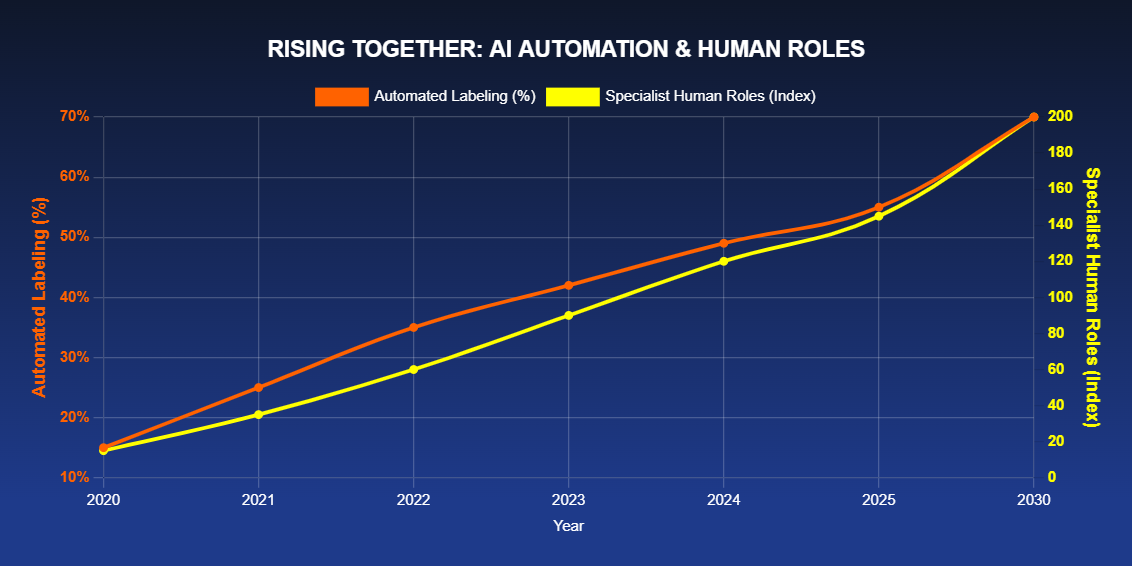
While automated labeling grew to 55% adoption by 2025, specialist human roles grew 130% in the same period, per IDC data.
Success Story
On Remotasks, automation pre-tags 70% of simple product images, but human annotators now focus on the 30% of complex cases that determine model quality—earning 40% higher rates for this specialized work.
Here's what makes this exciting: automation amplifies human capabilities rather than replacing them. When machines handle basic tagging, humans can focus on edge cases, ethical considerations, and complex reasoning that determine whether an AI system succeeds or fails. The result? Human work becomes more valuable, not less.
Synthetic Data: Fueling Demand for Human Expertise
Forget the myth that synthetic data is replacing humans. The reality is far more exciting: synthetic data is creating a surge in high-paying roles for human experts. From validating AI-generated outputs to ensuring fairness, cultural relevance, and accuracy, human intelligence is now the cornerstone of synthetic data success.
The global synthetic data generation market was valued at $351 million in 2023 and is projected to exceed $2.3 billion by 2030, growing at a compound annual rate of over 31% (Fortune Business Insights). This growth is already generating demand for new career paths that didn't exist just a few years ago.
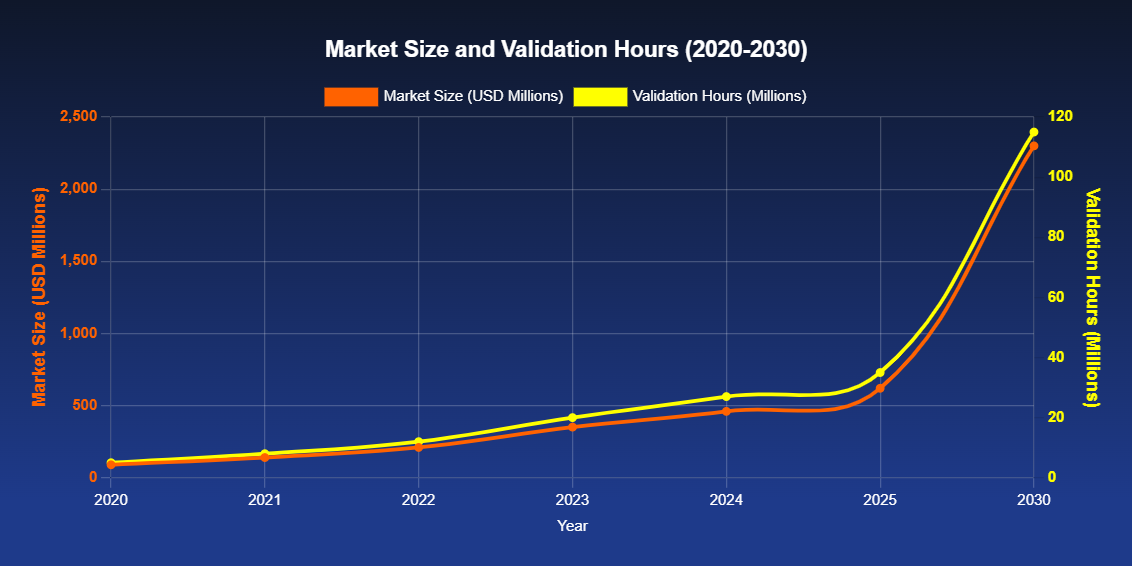
Market size for AI validation services grew from $90M in 2020 to a projected $2.3B by 2030, with validation hours increasing 23x in the same period, per industry projections.
Career Growth Drivers
With synthetic data adoption soaring, companies are investing heavily in human-in-the-loop roles to ensure data quality, bias detection, and regulatory alignment—driving a new wave of career opportunity.
In-demand roles and salary ranges:
- Synthetic Data QA Specialists: $110,000–$160,000 annually to verify data integrity
- Bias & Fairness Auditors: $130,000–$200,000+ to detect model risks and ensure ethical alignment
- Contextual Validation Experts: $150,000–$220,000 to align AI with diverse cultural and real-world expectations
- Regulatory Compliance Reviewers: $120,000–$180,000+ to align datasets with evolving legal standards
Success Story: From Annotator to AI Data Strategist
Toloka / OpenAI VendorJamal Rivera began his AI journey in 2021 labeling customer service chats. In just three years, he became a synthetic data quality lead earning over $150,000/year. "These roles didn't exist when I started," Jamal shares. "Now, I lead a team validating synthetic training data for autonomous driving systems."
"Human expertise isn't being automated away—it's being upgraded."
Data-backed impact: Studies show that for every 1,000 synthetic data points generated, 50–90 human validation hours are required to meet production standards—creating a multiplier effect where more data equals more human opportunity.
The Human Advantage: Why AI Needs Human Intelligence to Succeed
The more advanced AI becomes, the more it reveals the unique strengths of human intelligence. Complex reasoning, ethical judgment, and cultural understanding aren't just nice-to-have extras—they're the foundation of AI systems that actually work in the real world.
Here's where humans consistently outperform even the most sophisticated automation. For a deeper dive into AI training concepts, check our AI Training Glossary:
Game-Changing Impact: Maria's Expertise
Scale AIMaria, a Scale AI safety specialist, recently prevented a major AI system failure by catching subtle sarcasm that automated systems completely missed. Her intervention saved the company an estimated $2.3 million in potential damages and earned her a promotion to Lead Safety Auditor.
"Human intelligence isn't competing with AI—we're what makes AI actually intelligent," she explained.
Humans provide irreplaceable value through:
- Contextual Intelligence: Understanding sarcasm, cultural nuances, and implied meanings that determine AI safety
- Ethical Reasoning: Making complex moral judgments that automated systems simply cannot handle
- Creative Problem-Solving: Identifying novel edge cases and developing innovative training approaches
- Quality Assurance: Ensuring AI systems work reliably in real-world conditions
Industry Data
A 2025 xAI report found that human oversight increases model safety by 45% and reduces deployment failures by 67% in RLHF tasks—making human expertise essential for AI success.
The Evolution of Human Roles: From Workers to AI Intelligence Partners
The AI revolution isn't eliminating human jobs—it's elevating them to unprecedented levels of importance and compensation. Today's human AI trainers are becoming the architects of intelligent systems, with roles that command premium salaries and require advanced human judgment.
Today's human AI trainers are becoming the architects of intelligent systems, with specialized roles commanding premium salaries:
- AI Safety Engineers: $80,000-$150,000+ annually
- Model Behavior Specialists: $85,000-$160,000+ annually
- Ethical AI Supervisors: $90,000-$170,000+ annually
A 2024 Upwork study shows that 85% of new AI training positions now require advanced human judgment and strategic thinking. Explore detailed career paths and progression opportunities.
Career Transformation: Jamal's Success
TELUSJamal transformed his career from $12/hour basic labeling to a $65/hour AI Quality Architect role, where he designs training protocols for autonomous vehicle systems. His human expertise in edge case identification is now considered mission-critical.
"I'm not just training AI—I'm teaching it to think safely and ethically. My judgment could literally save lives," he shared.
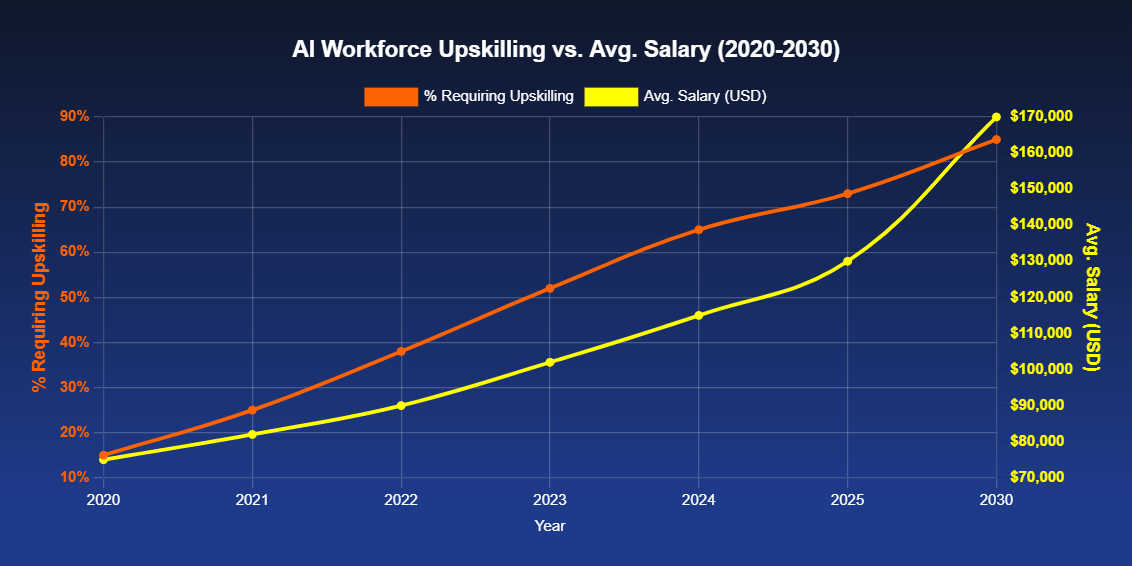
Average salaries for advanced AI training roles are projected to climb from $75K in 2020 to $170K by 2030, driven by surging demand for human expertise, per Gartner data.
Market Growth
Advanced human AI roles are projected to grow 350% annually through 2030, with demand far exceeding supply, per Gartner research.
Securing Your Future: 5 Strategies to Become an Indispensable AI Intelligence Partner
The future belongs to humans who understand how to work alongside AI systems as intelligence partners. Here's how to position yourself for the highest-value roles in this expanding field, where your human expertise becomes the most valuable asset.
Here's how to position yourself for the highest-value roles in this expanding field. For step-by-step guidance, see our Get Your First Job guide:
- Develop Advanced AI Collaboration Skills: Master platforms like Label Studio and CVAT, but focus on understanding AI reasoning patterns. A 2024 Kaggle specialization in "AI-Human Collaboration" led to average salary increases of 120%. Find the best tools and resources for your journey.
- Specialize in High-Stakes Domains: Focus on healthcare, autonomous systems, or financial AI where human judgment is literally life-or-death. These roles pay $60-$120/hour because human expertise is irreplaceable.
- Master AI Ethics and Safety: Become an expert in bias detection, fairness evaluation, and ethical AI development. These are the fastest-growing and highest-paid segments of the field.
- Lead Human-AI Teams: Develop skills in managing hybrid human-AI workflows. Team leads who can optimize human-AI collaboration earn 150-300% more than individual contributors.
- Build Your Professional Network: Connect with AI researchers, ethicists, and industry leaders. The highest-paying opportunities are shared within professional networks before they're publicly posted. Browse current job listings to see what's available.
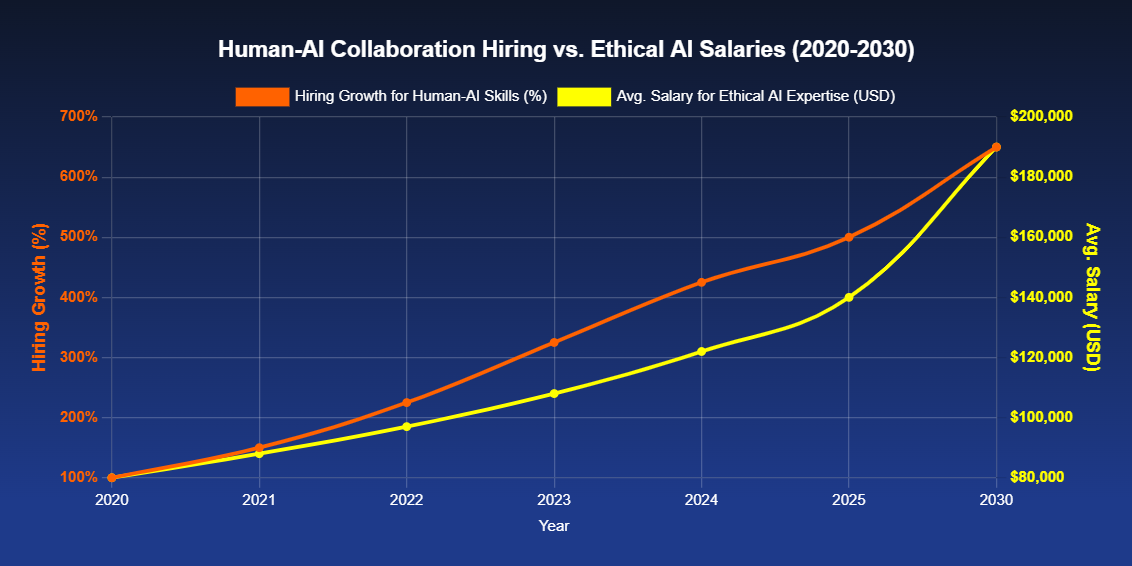
Human-AI collaboration skills saw 400% hiring growth by 2025, while ethical AI expertise salaries rose from $80,000 to $140,000, per Upwork and industry projections.
The Symbiotic Future: Humans as the Heart of Intelligent AI
The future of AI isn't artificial intelligence replacing human intelligence—it's about creating augmented intelligence where human creativity, judgment, and wisdom guide AI capabilities toward beneficial outcomes. Every breakthrough in AI technology creates new opportunities for humans to apply uniquely human skills at a higher level.
A 2025 MIT study found that the most successful AI systems combine automated processing with human insight, achieving 60% better results than either approach alone.
Global Impact: Aisha's Innovation
ClickworkerAisha, now a Senior Voice AI Specialist, developed new training methodologies that helped a major voice assistant understand 47 different languages and dialects. Her work directly improved AI accessibility for over 200 million users worldwide.
"I'm not just working with AI—I'm shaping how AI understands and serves humanity. That's the most exciting job in the world," she explained.
Conclusion: Your Essential Role in AI's Future
The AI revolution isn't coming for human jobs—it's creating the most exciting, well-compensated, and impactful career opportunities in human history. As AI systems become more powerful, the need for human intelligence, creativity, and ethical judgment becomes more critical than ever.
As AI systems become more powerful, the need for human intelligence, creativity, and ethical judgment becomes more critical than ever. Ready to start your journey? Check out our FAQ section for answers to common questions.
Your next steps are clear:
- Position yourself as an essential partner in AI development
- Build specialized skills in human-in-the-loop processes
- Join professional communities and networks
- Prepare for a career where your human intelligence is the most valuable asset in the AI ecosystem
The future needs you—and it's willing to pay premium rates for your expertise.
Ready to Transform Your Career?
Join thousands of successful AI trainers who started with a plan