
AI training projects are the gig economy's hidden gem, offering remote work, flexible hours, and a front-row seat to cutting-edge tech. But what's the day-to-day reality? Is it a dream job or a grind? This insider's guide pulls back the curtain with real-world stories, hard data, practical tips, and vivid visuals to show you exactly what it's like—and how to excel.
Whether you're eyeing your first gig on Appen or aiming for a $30/hour QA role, read on to unlock the secrets of AI training work!
- 1.5 million people globally work in AI data training (McKinsey 2025)
- Remote work with flexible hours available on major platforms
- Pay ranges from $8-$30/hour depending on task complexity
- Career progression opportunities from annotator to QA to prompt engineer
Welcome to the Human-in-the-Loop World
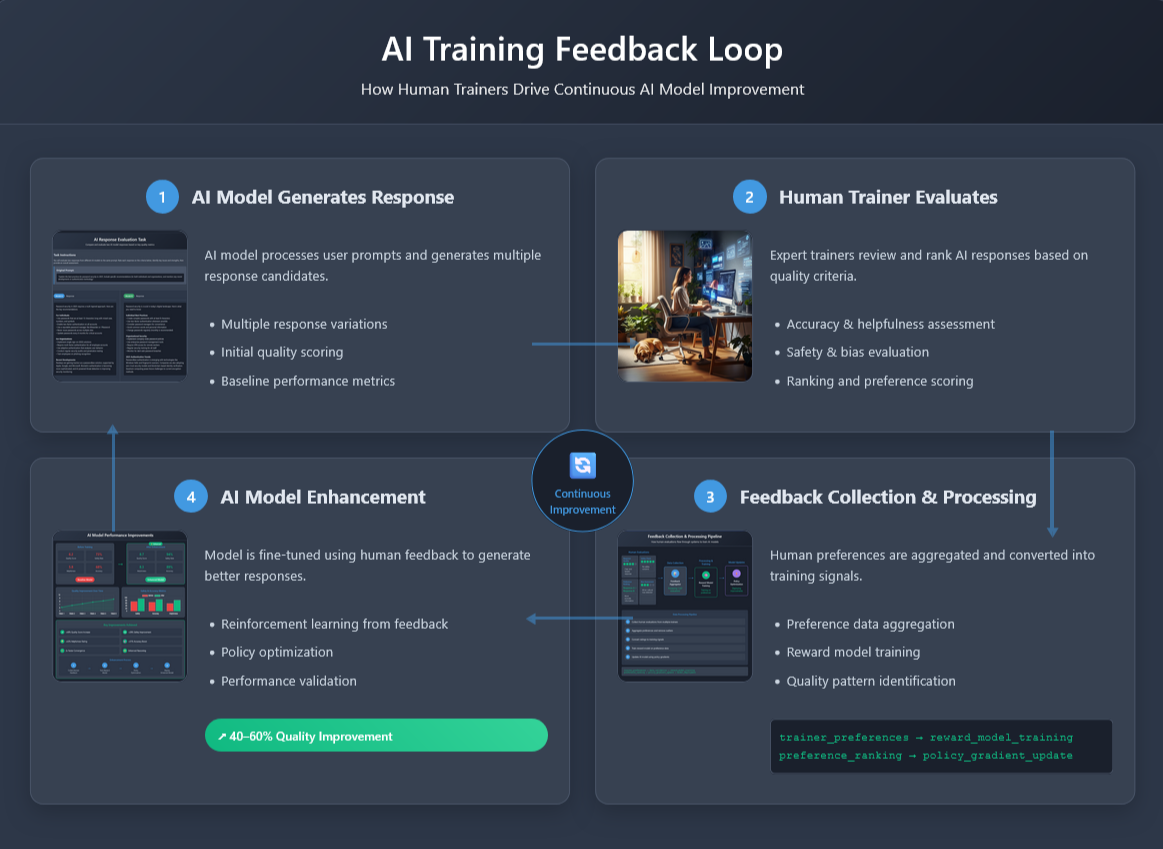
AI models don't magically "learn"—they rely on humans to label data, rank responses, and catch errors. This "human-in-the-loop" process powers everything from chatbots to autonomous vehicles.
In 2025, over 1.5 million people globally work in AI data training, per a McKinsey report, with platforms like Remotasks, Scale AI, and TELUS International leading the charge. As an annotator or evaluator, you're the unsung hero shaping AI's future. But what does a typical day look like? Let's dive in.
Your Role Matters
Every label you create, every response you rank, and every error you catch directly improves AI models that millions of people use daily.
The Core Tasks: What You'll Actually Do
AI training projects involve three main task families, each with unique skills and pay. Here's a breakdown:
Labeling/Annotation
Draw bounding boxes on images, tag text sentiment, transcribe audio.
Time to Master: 1-2 weeks
Ranking/Evaluation
Compare AI outputs, score chatbot responses for accuracy or safety.
Time to Master: 2-4 weeks
Quality Assurance (QA)
Audit annotators' work, resolve disputes, clarify guidelines.
Time to Master: 3-6 months
Content Moderation
Review and filter inappropriate content, ensure AI safety standards.
Time to Master: 2-3 weeks
Source
Mid-2025 global rates from Upwork and X posts; U.S./EU rates trend higher.
Real-World Example
Priya, a Remotasks annotator (anonymized from a 2024 X post), labels 200 images daily for a retail AI model, drawing boxes around products. She earns $12/hour and mastered the task in 10 days. "It's like a game once you get the rhythm," she says.
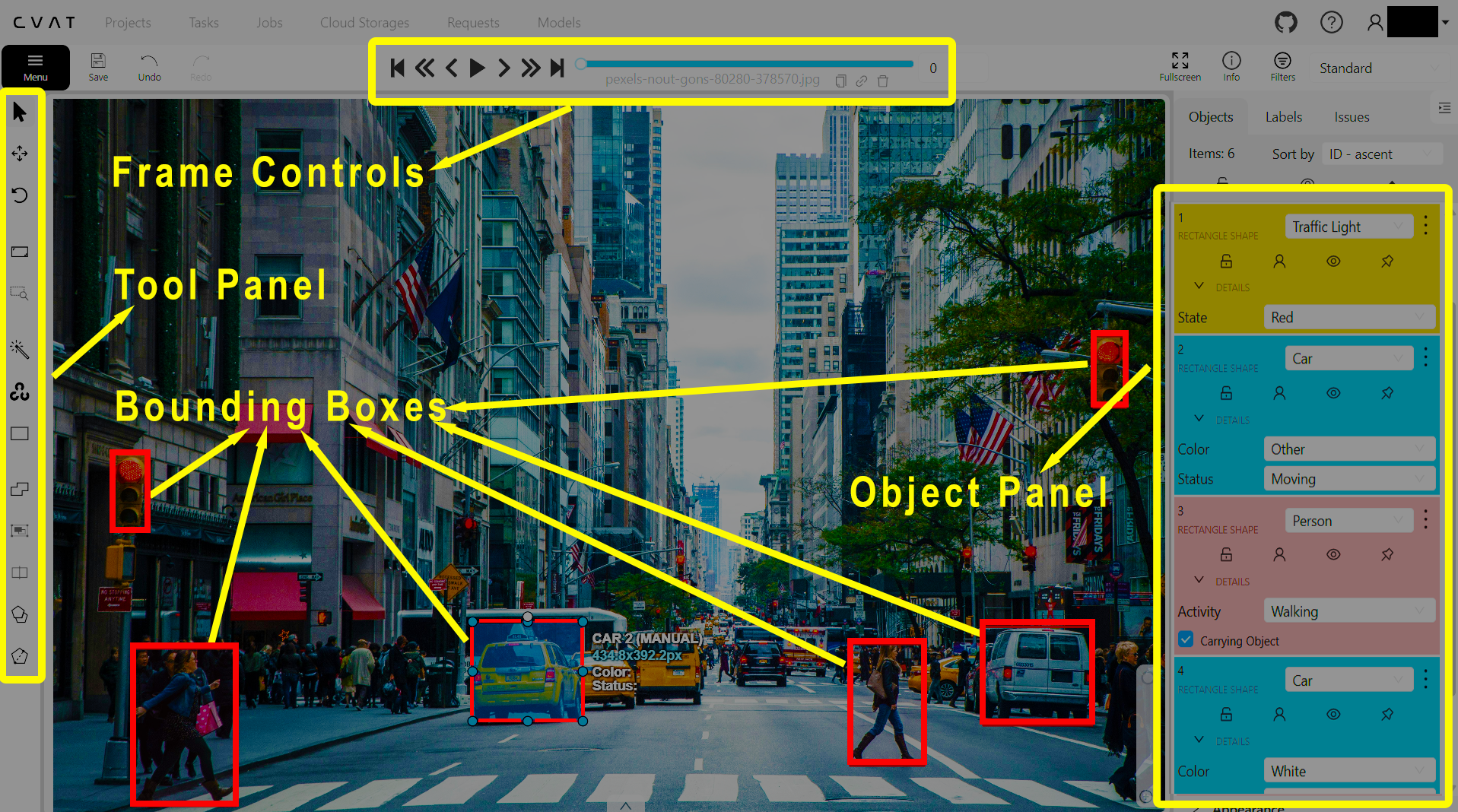
Example of drawing bounding boxes around products in a retail image, a common annotation task on Label Studio.
A Day in the Life: Platforms and Workflow
AI training platforms like Appen Connect, Labelbox, or Scale AI's custom dashboards are your workplace. Here's how a typical project flows:
- Task Queue: Log in to see a list of tasks (e.g., "Label 50 images" or "Rank 20 chatbot responses"). Reserve one to start.
- KPI: Tasks completed per hour.
- Annotation Interface: Use tools like CVAT for images or Appen's text rubric to label or score. Guidelines are detailed—e.g., "Tag 'happy' for positive emojis."
- Auto-Checks: Instant feedback flags errors (e.g., missed label). Fix them to maintain accuracy.
- KPI: Self-correction rate.
- Human QA Review: Senior reviewers audit 5-15% of your work, ensuring 95%+ accuracy.
- KPI: Final QA score.
- Metrics & Pay: Weekly dashboards show your accuracy, speed, and earnings. Exceed 97% for bonuses or priority tasks.
Sample CVAT interface for drawing bounding boxes, with guidelines on the right.
Data Point
A 2024 Scale AI report found annotators with 97%+ accuracy earn 30% more tasks than those at 90-95%.
Real-World Example
Jamal, a TELUS evaluator (from a 2025 Reddit thread), ranks chatbot responses for safety. He scores 100 responses daily on a custom platform, earning $20/hour. "The dashboard tracks everything—speed, clicks, even my QA feedback," he notes.
How Your Work Is Tracked: The Surveillance Reality
Platforms monitor performance with laser focus to ensure quality:
- Contributor ID: Links every task to you for audits.
- Metadata: Tracks time spent, clicks, and even mouse movements on some projects.
- Gold-Standard Traps: Hidden pre-labeled tasks test your vigilance. Miss one? Your score dips.
- Rolling QA Windows: Your last 200-300 tasks determine your average. A bad day can freeze your account.
Reality Check
A 2024 X post by @AIAnnotatorGuru revealed they were paused on Appen after dropping to 87% accuracy during a rushed shift. "One mistake snowballs if you're not careful," they warned.
Pro Tip
Screenshot QA feedback to appeal disputes or study mistakes. Keep a personal log of your accuracy (e.g., 96.5% over 500 tasks) to track progress.
Beating the Monotony: Challenges and Solutions
AI training can be repetitive, but pros use strategies to stay sharp:
Repetitive Clicks
Wrist strain
Symptom
Use ergonomic tools; learn shortcuts (e.g., Labelbox's "B" for box).
Visual Fatigue
Blurry eyes
Symptom
Follow 20-20-20 rule: every 20 min, look 20 ft away for 20 sec.
Mental Drift
Missing edge cases
Symptom
Work 90-min sprints with 10-min breaks.
Isolation
Loneliness
Symptom
Join platform Discord or X communities for peer support.
Real-World Example
Lisa, a Scale AI annotator (from a 2024 LinkedIn post), uses a $15 AutoHotkey script to automate repetitive clicks, boosting her output by 15%. She also joins Scale's Slack to swap tips, reducing isolation.
Sample Pomodoro app tracking 90-min work sprints, a trick to maintain focus.
Secrets of Top Earners: 5 Habits to Boost Your Pay
High earners treat AI training like a craft. Here's what they do differently:
- Read Guidelines Twice: Missteps waste time. A 2025 Reddit post by u/LabelPro123 said, "I cut errors by 50% by skimming rules twice before starting."
- Batch Tasks: Cherry-pick similar tasks for flow. E.g., label 50 images before switching to text.
- Use Macros: A two-line AutoHotkey script can speed up bounding boxes by 1-2 seconds each.
- Track Metrics: Log accuracy and speed in a spreadsheet to spot trends.
- Upskill Quarterly: Learn LiDAR annotation or Python basics to unlock $20-$30/hour roles.
Data Point
A 2024 Upwork study found annotators with scripting skills (e.g., Python) earn 40% more than those without.
Career Ladders: Where This Work Can Take You
AI training isn't a dead-end gig. Here's how to climb:
QA Reviewer
Time to Reach: 3-6 months
Pay Jump: +30-50%
Task Ops/Lead
Time to Reach: 6-12 months
Pay Jump: +100%
Prompt Engineer
Time to Reach: 1-2 years
Pay Jump: +150-200%
AI Training Specialist
Time to Reach: 2-3 years
Pay Jump: +200-300%
Real-World Example
A 2025 X post by @DataNinjaX moved from $10/hour annotation to a $28/hour QA role at Invisible Technologies in 8 months by maintaining 98% accuracy and earning a CVAT certification.
The Big Picture: Why Your Work Matters
Your labels and feedback make AI models smarter and safer. For example, accurate bounding boxes help self-driving cars avoid pedestrians, while RLHF evaluations keep chatbots helpful. A 2024 TED study estimated human annotators improve model performance by 20-30% in safety-critical tasks.
Final Story
Meet Aisha, a Clickworker annotator (2024 X post). She tags audio for a voice assistant, earning $15/hour. When her model launched, she heard it answer her friend's query perfectly. "I felt like I made AI real," she said.
Conclusion: Ready to Master AI Training?
AI training projects are a blend of puzzle-solving and precision, with challenges like monotony but rewards like flexibility and growth. By mastering platforms, tracking metrics, and upskilling, you can turn a $10/hour gig into a $30/hour career.
Start today: join Remotasks, practice on Label Studio, and track your first week's accuracy. Share your journey on X—we're rooting for you!
Your Next Steps:
- Join platforms: Start with Remotasks or Appen
- Practice skills: Use Label Studio for free
- Track progress: Monitor your accuracy and speed
- Share your journey: Connect with the community on X
- Keep learning: Explore our AI Training Glossary
We're rooting for you! What's your biggest question about AI training? Drop it below, and we'll answer in our next post!
Ready to Start Your AI Training Journey?
Join thousands of successful AI trainers who started with a plan